Hearth is the product behind CasaHub AI’s private workspace: a single binary you point at a directory to get a browser-based workspace with an AI agent that cannot leave it — and, with one flag, a household server the rest of your family signs into.
What It Is
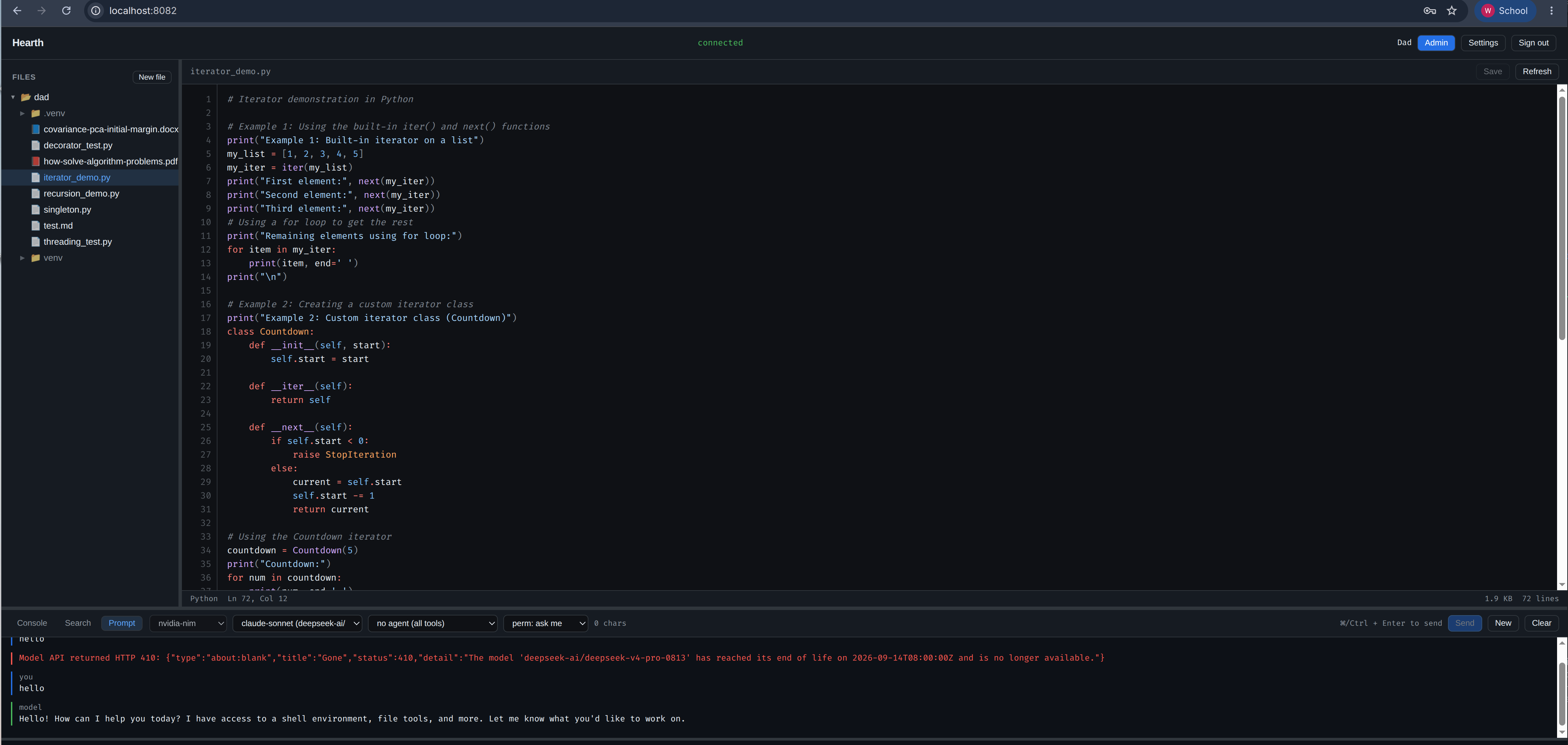
Point Hearth at a directory and open a browser. You get a file tree, an editor, a terminal, and an AI agent that can read, edit and run things — but only inside that directory. There’s no separate app to install on the client side: the page is plain HTML and JavaScript, served by the same binary.
Add one flag and the same binary becomes a household server: a sign-in page, a workspace of their own for each person, and rules about who gets which model. Nothing about that half turns on until you ask for it — a single-person install stays exactly that.
Where It Runs
Hearth is a small, native binary with no frontend build step, so it’s built to live on whatever’s already on and quiet in the house rather than demand a dedicated machine:
- Raspberry Pi 4 or 5 — enough for one person’s workspace and agent.
- A mini PC (Intel NUC, Beelink, and similar) — enough for a full household.
- Anything in between, including a machine you already own.
The mini-PC case is worth calling out on its own: the same low-power box that’s already serving as your household’s NAS can run Hearth alongside it, so the family’s files and the workspace sitting on top of them live on one always-on device instead of two.
For Everyone: Your Workspace
Whether you’re the only person using Hearth or one of several:
- Browse, edit, and run — a file tree, a code/text editor, and a terminal, all in one page.
- Search that means it — find text across files, find files by name, and preview a search-and-replace before committing to it.
- An agent that stays put — ask it to read, change, or run something, and watch each step as it happens. Anything it hasn’t already been cleared to do stops and asks you first — once, for the session, or always for calls like it.
- Documents, not just code — Markdown renders live, PDFs stream in the viewer, and Word documents (equations included) read directly in the page.
For the Workspace Admin: Running It for a Household
Turning on accounts turns Hearth into something you run for people, not just for yourself:
- A workspace and a model set per person. Everyone gets their own directory; you decide which models each person can reach, from “the fast local one” to everything.
- Rules you can set on someone else’s account — built for parental controls: patterns that hold back what a member sends a model or gets back, which the member they apply to can’t see or change.
- A record of what happened — including a log if you, as the admin, ever open someone else’s workspace yourself.
- Budgets you can see and move — limits on file size, run time, how many things can happen at once — listed with their bounds in a settings page, most changeable without restarting the server.
For Advanced Users: Point Your Coding Tools At It
Hearth can also be the model endpoint your coding tools talk to. Instead of Claude Code, Codex, or any OpenAI-compatible coding CLI reaching a provider directly, you point it at your Hearth server instead.
- The setup follows the tool, not the other way around. Hearth hands the CLI ready-made configuration and a personal access token — there’s no hand-editing environment variables or config files.
- The household’s rules travel with you. Whichever models you’re allowed, whatever content rules apply to your account, and a log of what ran — all of it now covers your coding agent too, not just the browser tab.
- Usage stays visible and capped. A daily allowance and a concurrency limit keep one runaway session from turning into a surprise bill, and what’s been used today is visible in the same settings page.
One boundary worth being direct about: this governs identity and policy — which model you get, what’s allowed through, what’s logged. It does not reach into the coding tool itself; that agent still runs on your own machine and acts there, under whatever controls it already has.
Getting Started
Hearth is self-hosted software you run on hardware you already have. If you’d like a hand picking the hardware, setting it up, or configuring it for your household, that’s exactly what our services are for.